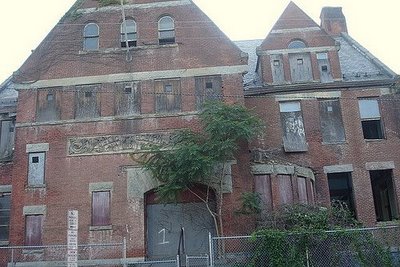
07/20/09 8:00am

A while ago I blogged about what was happening with the Liberty Street School. Well, since then some bricks have been going up . The above image might not look like much of an improvement, but look below and you’ll see that it’s a huge step forward. Switch your eye between the two pictures and you’ll see not only has the brickwork been restored, but also the huge slabs of stone that run above and below the windows (even though some is still missing). Hopefully the developers can speedy it up with the rest of the work. Nearby store owner, Nancy, said that within a few days they were able to fix the bricks very quickly and professionally. We can only imagine the improvement if they continue their work. There’s a little hope left that something good will come out of this building yet-regardless of it’s intended purpose. There is also work being done on the train station as well…..blog entry to follow. For more positive Newburgh news check out this link.

07/18/09 8:02am
(source) 

Habitat for Humanity are not the only ones restoring in Newburgh. Polonia Architectural Restoration also has been assigned to part of the restoration of Newburgh. I’m not quite sure what organization or whom assigned them to this building. But they have it listed as the Affinity Building. They did a great job. Looking at their portfolio, they have a couple of significant structures they have helped restore-such as the Brooklyn Museum of Art, the Dutch Reformed Church in Newburgh, and the US Embassy Building in Athens, Greece. I’ll be positing more pictures to come.
06/08/09 8:45am
176 Broadway


When cruising through Newburgh, vacant store fronts and buildings are part of the landscape. But what if there was a way to brighten up these bleak storefronts? An idea that is being used all around the country and world, is using empty store fronts as a center stage for displaying art, also known as Phantom Galleries. Landlords have to agree for the space usage, but it livens up even the most dreary streets, and it beautifies their property while it is empty or in the process of being rented. This is an increasing popular idea for artists who want to make their work known. Displaying art in public spaces is one of the most direct methods to have the public view your artwork. You bring the art to them. Most artists that are show cased are local and come from local schools and universities. 

It should be noted that this has been a success in other cities like Pittsfield and Northampton, Massachusets. Below is a photo from an empty storefront in downtown Berkley, California that is showcasing artwork in a former shoe store.

(source) 

The Marketing Manager of the program said this to the Daily Californian, “We really wanted to bring the community into the Downtown. We wanted to make it fun and bright, celebrating the Downtown instead of letting it feel dismal and empty.” With their empty commercial space rising, they looked to local artists to fill in some of the gaps. 

Design by Dakin Roy & Sonia Roy
(source) 

This is even happening across the river in nearby Beacon at their 2009 Windows on Main Street event. So far this will be it’s fifth year running. It will run from August 8-September 12, 2009 this year. I know that a gallery in Beacon is interested in bringing the same thing to Newburgh.


Charleston, SC also has it’s share of empty storefronts. But they have the WALK Gallery (Window Art Local Knowledge). Their mission is to “to expand on the existing dialogue of community art.” The gallery is “capitalizing on shifting the current economic paradigm by enlivening empty spaces to showcase our culture’s commodities by filling these spaces and bringing attention to our most creative class — visual artists.” They are trying to create a neighborhood “where empty becomes full and “vacant” no longer has a negative connotation.”

(source) 

The above image is an example of how a new store used art to cover up the raw bones of the space in Clinton Hill, Brooklyn. Flickr has a great photo stream of Phantom Galleries. Really the possibilities are endless, even performing arts are taking place in these type of spaces. 

So the question is how can something like this be brought to Newburgh? Well all communities seem to have a common thread in common-they are all well organized groups with missions and have a specific plan outlined. Floor One, a gallery in nearby Beacon has expressed interest in organizing such a project. If there are any local artists or more specifically-landlords that would be interested in such a task please contact them 17EastMain@gmail.com . Also the Newburgh Arts & Culture Commission could be contacted as well arts@cityofnewburgh-ny.gov . The local public schools, Orange County Community College, and Mount Saint Mary’s College could also have students work showcased. This idea worked well with a University in Pennsylvania. They painted scenes of busy shops and placed them in the empty storefronts. Perhaps the director of Ann Street Gallery would be interested too. If local people get involved, then they will take pride in their community.

05/18/09 10:00am

This house was dedicated on July 29, 2006. Habitat received the house in 2005. The house still had some furnishings inside including a child’s bed and a refrigerator with food still inside! In the renovation they were even able to remove the paint off of the brick. What a wonderful way to restore some of the charm and character from the home. I am happy to see as well that the porch was rebuilt, even if it is lacking some of the original decorative features. But the finished product looks 10 times better!

04/20/09 8:00am
(photos from Newburgh Habitat) 

This house was in a deplorable state back in 2006. But by December 2006 the house had been cleaned up of all it’s asbestos. It had been abandoned for over a decade and looks like it could very well have been razed. But Thrivent Builds along with Habitat for Humanity saved this house and dedicated the house to the Segarra Family. 

02/11/09 10:00am
(Pictures taken from Habitat for Humanity)

Habitat for Humanity did not really have any great information on the restoration of these two houses. What they did mention, and what is obvious is that the rehabilitation of homes changes the feeling of an entire block, and it inspires neighbors to work on their own homes and thus begins the transformation of a neighborhood (baby steps). I think these two are historically accurate in comparison to some other projects that have taken away from the homes exterior architecture. Great job.

For information on volunteering with Habitat for Humanity on projects restoring homes such as these in Newburgh click here.

The founder of Habitat for Humanity, Millard Fuller, passed away last week on February 3rd, at the age of 74. Click here to see his obituary in the Herald Tribune.