03/31/11 10:00am

Mark your calendars for this presentation on sustainable roofing. Location:

Orange County
Wednesday, April 6th, 6-8 PM
John’s Harvest Inn
17M, Middletown, NY

Much of conventional roofing represents a wasted opportunity to reduce energy costs, improve building performance and durability, create usable habitat for flora and fauna, improve biodiversity, increase the performance of installed photovoltaic systems, mitigate combined sewer overflow (CSO) events, reduce waste stream pollution, lessen urban heat island effects (UHIE) and make the “view from the top” a much prettier place.  Our experts on sustainable roofing will talk about proven roofing alternatives that can do all these things, turning underutilized dark roof surfaces into acres of better space for the environment, for occupants, and for owners. Participants will gain a strong understanding of innovative roofing technologies such as cool roofs, photovoltaic roofing, vegetative roof systems, recyclable roofing, and roofing materials manufactured with post-consumer recycled content and low VOC roofing options. You can register for the lecture on their website.


02/24/11 10:15am

I’m quite excited about this small feature inside the March/April 2011 Preservation Magazine. They have a section of the magazine called “Transitions” where they discuss historic properties that are in limbo, threatened, lost, restored, or saved.  I instantly thought that the success story of the Westshore Train Station would be an excellent addition for a restored story. I wrote the magazine, which in turn was able to speak to the Tran Station’s owner Ray Yannone. Now, Newburgh is in a national magazine for something positive. You can check out this link or read the small excerpt below:

Newburgh West Shore Train Station In 1909, architects Whitney Warren and Charles Wetmore designed this depot for Newburgh, N.Y., a few years before completing their most celebrated commission, Grand Central Terminal. Newburgh’s station closed in 1958, subsequently enduring multiple fires and decades of neglect. In November, the building reopened after a local businessman purchased the property and restored it as a playhouse and restaurant.”

I just want to mention that this was as easy as writing an email. Anyone has the opportunity to put Newburgh in a positive light. For more positive Newburgh news check out this link.

12/20/10 9:30am

Click to Enlarge

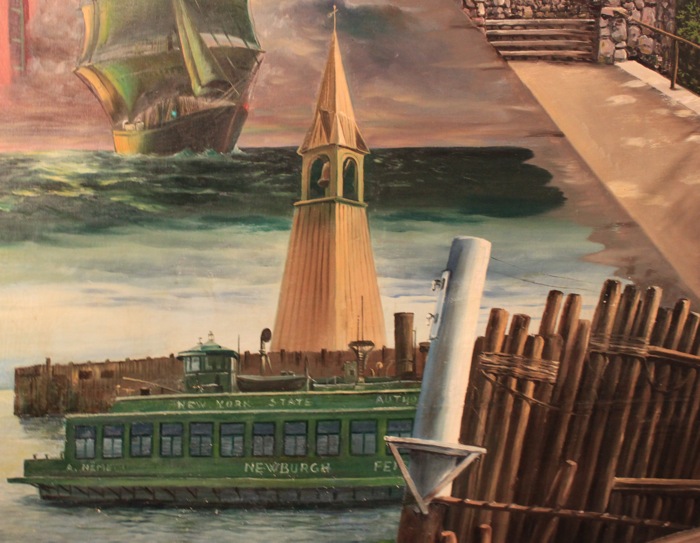
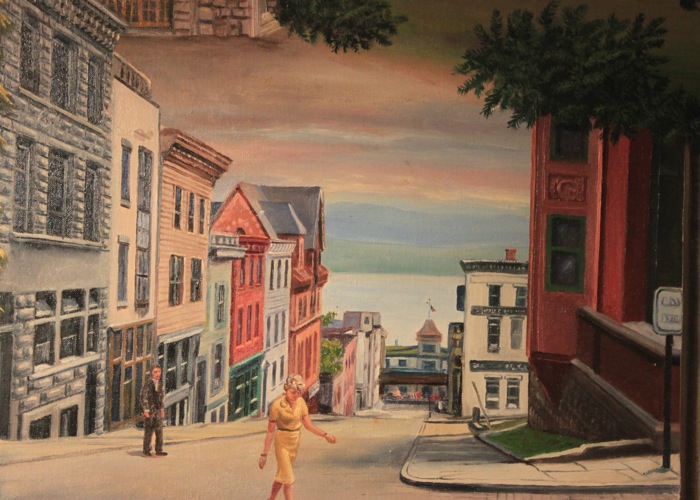
The Newburgh Panorama Mural is a representation of the pride of Newburgh in it’s glory days. One look at this painting and you can see why. The mural was painted by Albert Nemethy in 1950 and was commissioned by Abram and Eva Levinson, owners of the former Hotel Newburgh. They had it commissioned especially for the Green Room to show case Newburgh architecture. The mural is still in the Green Room if you would like to view it for yourself.

With the hotel going in a steep decline in the 1970’s, it was saved by the Newburgh Historical Society and moved to a bank. In 1996 it was moved to Stewart Airport where it stayed until 2006 when the Green Room was restored by Safe Harbors of the Hudson (the organization that presides over the Green Room and Ritz Theater) and had a grand opening at their gala. I love looking at this painting as it shows parts of a Newburgh that many of us never got to see.

There are over 20 individual Newburgh scenes painted in this mural. It is a rather large painting, so I took pictures of each individual scene. Some of the places are long gone now and some still exist. If you remember any of the vanished places, feel free to comment on what we see in the scene. Thank you Safe Harbors for letting me come in and share the mural!

11/10/10 10:45am

Here is a nice little feature of  Newburgh Habitat for Humanity in the National Trust for Historic Preservation website. Newburgh was featured along with 6 other communities as successful case studies for Habitat preservation.

“Habitat for Humanity of Greater Newburgh (HFHGN) was established in 1999 and immediately set to work rehabilitating houses in the Washington Heights neighborhood, a part of the large East End historic district. In its brief history, HFHGN has completed 23 rehabilitation projects and constructed 20 new houses.  According to Executive Director Deirdre Glenn, the affiliate began work in the Washington Heights neighborhood with the hope that affordable rehabilitation of existing homes would ease the widespread problems of overcrowding and neglect, and bring the formally vibrant late-19th-century neighborhood back to life. “

Read the rest of the article here! In just 11 years Habitat has had a huge influence in Newburgh. The future can only be brighter. For more positive Newburgh news check out this link.

The above title comes from a Weatherization For Old Houses Toolkit from the NYS Parks Division for Historic Preservation. It’s a nice little guide that looks at everything for restoring and repairing old windows…sort of along the same lines as a post we mentioned a few weeks back. Here’s a little sampling of what the toolkit mentions:

“You will be surprised how cost-effective combining historic preservation and new technology can be, and how much work you can do yourself or with the assistance of a skilled contractor! Think of your house as a long-term project; allocate a number of dollars and hours for work each month. Our toolkit offers an overview of what can be done, and recommends resources to help you evaluate the most economical approach in terms of short– and long-term payback of energy dollars.”

Mark your appointment books and register for this educational event.

Sustainable Restoration of Historic Buildings
: Transforming good old bones into enduring green classics

Tuesday, November 9th, 6-8 PM
SUNY Orange Library
115 South Street
Middletown, NY 10940
(845) 341-4855
(Click here for directions)
(Advance tickets for this event must be purchased through SUNY Orange)
Presented by Walter Sedovic,

Tuesday, November 16th, 6:30-8:30 PM
Howland Cultural Center
477 Main Street, Beacon, NY
(Click here for directions)
Held in a historic building with a new geothermal system!
Presented by Walter Sedovic

Historic buildings represent one of the most sustainable forms of construction, and many of these structures have inherent energy conserving features that are often overlooked. Unique approaches to rehabilitation and restoration are essential in order to preserve historic character and to minimize the potential for unintended consequences that may result from ill-conceived or poorly implemented energy-related upgrades.

To Register:
Ticket prices: $10 for advance sales to Chapter Members and Students, $15 for Members and Students at the door, and $20 for Non-members.
You may purchase tickets in advance on the main page of their calendar. If you intend to purchase tickets at the door please RSVP (HVBranchCoordinator{at}gmail.com) and indicate your date of attendance so they can get a headcount.